a 147 n iron ball weighs 15kg. what is the acceleration of the ball due to gravity
Learning Objectives
By the end of the section, you volition be able to:
- Explain the difference between mass and weight
- Explain why falling objects on Earth are never truly in free fall
- Describe the concept of weightlessness
Mass and weight are oftentimes used interchangeably in everyday conversation. For example, our medical records oftentimes show our weight in kilograms merely never in the correct units of newtons. In physics, even so, there is an of import distinction. Weight is the pull of Earth on an object. Information technology depends on the distance from the center of Earth. Unlike weight, mass does non vary with location. The mass of an object is the same on Earth, in orbit, or on the surface of the Moon.
Units of Strength
The equation [latex] {F}_{\text{net}}=ma [/latex] is used to ascertain net force in terms of mass, length, and time. As explained earlier, the SI unit of force is the newton. Since [latex] {F}_{\text{net}}=ma, [/latex]
[latex] 1\,\text{North}=1\,\text{kg}·{\text{m/s}}^{2}. [/latex]
Although virtually the unabridged world uses the newton for the unit of measurement of force, in the United states, the most familiar unit of forcefulness is the pound (lb), where ane N = 0.225 lb. Thus, a 225-lb person weighs 1000 N.
Weight and Gravitational Strength
When an object is dropped, it accelerates toward the center of Earth. Newton's second police says that a net force on an object is responsible for its acceleration. If air resistance is negligible, the net forcefulness on a falling object is the gravitational force, usually called its weight [latex] \overset{\to }{w} [/latex], or its force due to gravity acting on an object of mass m. Weight can exist denoted as a vector because it has a direction; downward is, past definition, the management of gravity, and hence, weight is a downward force. The magnitude of weight is denoted every bit w. Galileo was instrumental in showing that, in the absence of air resistance, all objects autumn with the aforementioned dispatch g. Using Galileo's consequence and Newton's second police force, nosotros can derive an equation for weight.
Consider an object with mass 1000 falling toward Earth. It experiences only the downward force of gravity, which is the weight [latex] \overset{\to }{w} [/latex]. Newton'due south 2nd constabulary says that the magnitude of the internet external force on an object is [latex] {\overset{\to }{F}}_{\text{net}}=one thousand\overset{\to }{a}. [/latex] We know that the dispatch of an object due to gravity is [latex] \overset{\to }{g}, [/latex] or [latex] \overset{\to }{a}=\overset{\to }{g} [/latex]. Substituting these into Newton'south 2nd law gives united states the following equations.
Weight
The gravitational strength on a mass is its weight. We can write this in vector form, where [latex] \overset{\to }{w} [/latex] is weight and k is mass, every bit
[latex] \overset{\to }{west}=thousand\overset{\to }{g}. [/latex]
In scalar course, nosotros can write
[latex] due west=mg. [/latex]
Since [latex] g=nine.80\,{\text{m/south}}^{two} [/latex] on Earth, the weight of a 1.00-kg object on Earth is nine.lxxx N:
[latex] w=mg=(ane.00\,\text{kg})({9.80\,\text{one thousand/s}}^{2})=9.fourscore\,\text{Due north}. [/latex]
When the net external force on an object is its weight, we say that it is in gratis fall, that is, the only force acting on the object is gravity. All the same, when objects on Earth fall downwardly, they are never truly in costless fall because there is always some upward resistance force from the air acting on the object.
Acceleration due to gravity one thousand varies slightly over the surface of Globe, so the weight of an object depends on its location and is not an intrinsic property of the object. Weight varies dramatically if nosotros leave Globe'southward surface. On the Moon, for instance, dispatch due to gravity is simply [latex] {i.67\,\text{m/south}}^{2} [/latex]. A 1.0-kg mass thus has a weight of 9.8 N on Earth and only about 1.7 N on the Moon.
The broadest definition of weight in this sense is that the weight of an object is the gravitational strength on it from the nearest big body, such equally Earth, the Moon, or the Sun. This is the most mutual and useful definition of weight in physics. It differs dramatically, even so, from the definition of weight used by NASA and the popular media in relation to space travel and exploration. When they speak of "weightlessness" and "microgravity," they are referring to the phenomenon we call "complimentary fall" in physics. We use the preceding definition of weight, force [latex] \overset{\to }{w} [/latex] due to gravity acting on an object of mass k, and we brand careful distinctions between free fall and bodily weightlessness.
Be aware that weight and mass are different physical quantities, although they are closely related. Mass is an intrinsic holding of an object: It is a quantity of matter. The quantity or amount of thing of an object is adamant by the numbers of atoms and molecules of various types it contains. Because these numbers practise not vary, in Newtonian physics, mass does not vary; therefore, its response to an practical forcefulness does not vary. In contrast, weight is the gravitational force acting on an object, so it does vary depending on gravity. For example, a person closer to the centre of Earth, at a low peak such as New Orleans, weighs slightly more a person who is located in the college tiptop of Denver, even though they may have the same mass.
Information technology is tempting to equate mass to weight, because near of our examples take identify on Earth, where the weight of an object varies only a trivial with the location of the object. In add-on, information technology is difficult to count and identify all of the atoms and molecules in an object, so mass is rarely adamant in this style. If we consider situations in which [latex] \overset{\to }{m} [/latex] is a constant on Earth, we see that weight [latex] \overset{\to }{due west} [/latex] is directly proportional to mass m, since [latex] \overset{\to }{w}=yard\overset{\to }{g}, [/latex] that is, the more massive an object is, the more than it weighs. Operationally, the masses of objects are determined by comparing with the standard kilogram, equally we discussed in Units and Measurement. But past comparing an object on World with i on the Moon, we can easily see a variation in weight just not in mass. For instance, on Earth, a 5.0-kg object weighs 49 N; on the Moon, where yard is [latex] {1.67\,\text{chiliad/s}}^{2} [/latex], the object weighs 8.4 Northward. However, the mass of the object is nonetheless 5.0 kg on the Moon.
Example
Clearing a Field
A farmer is lifting some moderately heavy rocks from a field to establish crops. He lifts a stone that weighs 40.0 lb. (about 180 Northward). What force does he apply if the rock accelerates at a rate of [latex] 1.five\,{\text{m/s}}^{2}? [/latex]
Strategy
We were given the weight of the stone, which we use in finding the net force on the rock. However, nosotros also demand to know its mass to apply Newton's second police force, so nosotros must use the equation for weight, [latex] due west=mg [/latex], to determine the mass.
Solution
No forces act in the horizontal direction, so we can concentrate on vertical forces, equally shown in the following free-body diagram. We characterization the dispatch to the side; technically, it is non part of the free-body diagram, but it helps to remind us that the object accelerates up (so the cyberspace force is upward).
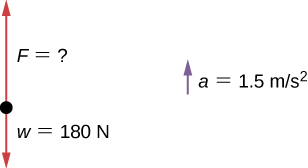
[latex] \begin{array}{ccc}\hfill w& =\hfill & mg\hfill \\ \hfill m& =\hfill & \frac{w}{g}=\frac{180\,\text{Northward}}{nine.8\,{\text{m/s}}^{2}}=18\,\text{kg}\hfill \\ \hfill \sum F& =\hfill & ma\hfill \\ \hfill F-due west& =\hfill & ma\hfill \\ \hfill F-180\,\text{N}& =\hfill & (eighteen\,\text{kg})(1.5\,{\text{m/s}}^{two})\hfill \\ \hfill F-180\,\text{Northward}& =\hfill & 27\,\text{N}\hfill \\ \hfill F& =\hfill & 207\,\text{Northward}=210\,\text{N to two significant figures}\hfill \end{array} [/latex]
Significance
To apply Newton's 2d law as the primary equation in solving a problem, nosotros sometimes have to rely on other equations, such as the ane for weight or 1 of the kinematic equations, to consummate the solution.
Check Your Understanding
For (Example), discover the acceleration when the farmer's applied strength is 230.0 N.
Prove Solution
[latex] a=2.78\,{\text{m/south}}^{ii} [/latex]
Tin can yous avert the boulder field and country safely merely before your fuel runs out, as Neil Armstrong did in 1969? This version of the classic video game accurately simulates the existent motion of the lunar lander, with the correct mass, thrust, fuel consumption charge per unit, and lunar gravity. The real lunar lander is difficult to control.
Use this interactive simulation to move the Sun, Globe, Moon, and infinite station to meet the effects on their gravitational forces and orbital paths. Visualize the sizes and distances betwixt different heavenly bodies, and turn off gravity to see what would happen without it.
Problems
The weight of an astronaut plus his infinite suit on the Moon is only 250 Northward. (a) How much does the suited astronaut weigh on Earth? (b) What is the mass on the Moon? On Earth?
Testify Solution
a. [latex] \brainstorm{assortment}{ccc}\hfill {w}_{\text{Moon}}& =\hfill & m{g}_{\text{Moon}}\hfill \\ \hfill one thousand& =\hfill & 150\,\text{kg}\hfill \\ \hfill {west}_{\text{Earth}}& =\hfill & 1.5\,×\,{x}^{iii}\,\text{N}\hfill \end{assortment} [/latex]; b. Mass does not modify, so the suited astronaut'southward mass on both Globe and the Moon is [latex] 150\,\text{kg.} [/latex]
Suppose the mass of a fully loaded module in which astronauts take off from the Moon is [latex] 1.00\,×\,{10}^{4} [/latex] kg. The thrust of its engines is [latex] three.00\,×\,{10}^{4} [/latex] N. (a) Summate the module's magnitude of acceleration in a vertical takeoff from the Moon. (b) Could it lift off from Earth? If non, why non? If it could, summate the magnitude of its dispatch.
A rocket sled accelerates at a rate of [latex] {49.0\,\text{thou/due south}}^{two} [/latex]. Its passenger has a mass of 75.0 kg. (a) Calculate the horizontal component of the strength the seat exerts against his body. Compare this with his weight using a ratio. (b) Calculate the direction and magnitude of the total force the seat exerts against his trunk.
Repeat the previous problem for a state of affairs in which the rocket sled decelerates at a rate of [latex] {201\,\text{1000/due south}}^{2} [/latex]. In this problem, the forces are exerted by the seat and the seat chugalug.
A body of mass two.00 kg is pushed straight upward by a 25.0 Due north vertical force. What is its acceleration?
Testify Solution
[latex] \brainstorm{assortment}{ccc}\hfill due west& =\hfill & 19.vi\,\text{N}\hfill \\ \hfill {F}_{\text{internet}}& =\hfill & 5.forty\,\text{Northward}\hfill \\ \hfill {F}_{\text{cyberspace}}& =\hfill & ma⇒a=2.lxx\,{\text{m/s}}^{2}\hfill \terminate{array} [/latex]
A car weighing 12,500 N starts from rest and accelerates to 83.0 km/h in v.00 southward. The friction strength is 1350 N. Discover the practical force produced by the engine.
A body with a mass of 10.0 kg is causeless to be in Earth'south gravitational field with [latex] 1000=nine.80\,{\text{m/s}}^{2} [/latex]. What is its acceleration?
Testify Solution
[latex] 0.lx\lid{i}-8.4\lid{j}\,{\text{m/s}}^{2} [/latex]
A fireman has mass m; he hears the fire alarm and slides down the pole with acceleration a (which is less than g in magnitude). (a) Write an equation giving the vertical force he must apply to the pole. (b) If his mass is 90.0 kg and he accelerates at [latex] v.00\,{\text{m/s}}^{2}, [/latex] what is the magnitude of his applied forcefulness?
A baseball game catcher is performing a stunt for a television commercial. He will catch a baseball (mass 145 m) dropped from a height of 60.0 thousand in a higher place his glove. His glove stops the brawl in 0.0100 s. What is the forcefulness exerted by his glove on the ball?
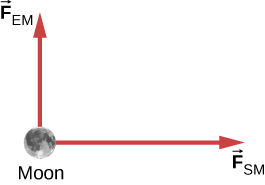
When the Moon is directly overhead at sunset, the strength by Globe on the Moon, [latex] {F}_{\text{EM}} [/latex], is essentially at [latex] xc\text{°} [/latex] to the strength by the Sun on the Moon, [latex] {F}_{\text{SM}} [/latex], as shown below. Given that [latex] {F}_{\text{EM}}=1.98\,×\,{10}^{twenty}\,\text{Northward} [/latex] and [latex] {F}_{\text{SM}}=iv.36\,×\,{ten}^{twenty}\,\text{North}, [/latex] all other forces on the Moon are negligible, and the mass of the Moon is [latex] 7.35\,×\,{10}^{22}\,\text{kg}, [/latex] determine the magnitude of the Moon'southward acceleration.
Source: https://courses.lumenlearning.com/suny-osuniversityphysics/chapter/5-4-mass-and-weight/
0 Response to "a 147 n iron ball weighs 15kg. what is the acceleration of the ball due to gravity"
Post a Comment